Pages

Showing posts with label Gear Reviews. Show all posts

Sunday, May 7, 2017

Casio SA76 44‑Key Mini Keyboard

Casio SA76 44-Key Mini Keyboard
I've been using a 61-Key Casio CTK-2300 digital piano keyboard for the purposes of better understanding harmony/chords as well as for ear training.  It's over 3-feet wide, so I've been looking for a more compact keyboard that I can hold in my lap and casually play on the couch.  The only requirements I had were:
-37 to 49 keys (less than 30" wide)
-Built-in speakers
-Ability to plug in headphones
-Wall socket / AC-adapter powered (not USB)
-Piano-like sound

Surprisingly, in this world of Amazon and eBay, I could only find two digital pianos currently available that met all of these criteria - one of them at $399 and one of them at $50.  Every other digital keyboard was either 61-keys or larger (I already have that) or some kind of computer-reliant MIDI/USB device (not interested).  I just need it to make a piano sound.

The $399 option was the Yamaha Reface series, particularly the Reface CP model.  I liked the fact that the Reface CP was a professional quality instrument with simple, easy to use knobs.  What I didn't like was the cost and the bad reviews regarding its built-in speakers.  If I had chosen the Reface it seemed like I may also have needed to purchase some kind of external speaker or amp to use with it.  I also didn't love the fact that it was only 37 keys, but I did like how that made it super-compact.  The vintage Rhodes, Clavinet and Wurlitzer sounds it contains weren't a big deal to me one way or another.  It was hard for me to tell who these Yamaha Reface mini keyboards were intended for.  Not for me, I guess.

So I chose the $50 keyboard, which is the Casio SA76.  Actually, it was more like $60 because the AC adapter that you need to plug it into the wall is an additional cost.  You could just use six "AA" batteries, but I wanted to be able to plug it in.  This instrument is definitely intended to be more of a child's toy, but it actually suits my needs quite nicely.  You get what you pay for so it's not anything all that incredible, but I like having it handy for working out things by ear and for reinforcing stuff that I am learning on a more full-size keyboard.

The SA76 has 44 mini-sized keys, but I actually don't mind this too much.  That is seven more keys than are on the Yamaha Reface, which are also mini-sized.  (As a stringed instrument player, I go back and forth between the tenor banjo's 21-inch scale and the mandolin's 14-inch scale without much trouble, so I'm not too worried about this when it comes to the piano keyboard).

I've hardly used any of the features of the SA76 thus far, and don't really intend to do much of that. When it arrived I simply turned it on and started playing. Usually I just scroll through the sounds it can make and find one within the first 10 that seems suitable to me at that moment.  If it just had one sound and that was a sampled "piano" sound it would be fine with me.  That's all I'm looking for.

So the verdict is I'm glad I found something.  It's surprising that there aren't any other keyboards like this besides these two.  If you know of any other digital pianos that meet all of the requirements above PLEASE leave a comment!  What I really would like is a smaller version of the Yamaha P-45, with 44 or 49 full-sized keys instead of 88.  That would still be compact enough but would be more playable.  Or maybe if the Reface model cut its price in half to $200 and improved its built-in speakers, then it would be the perfect mini keyboard.  For now I'm happy with the Casio SA76.

Tuesday, July 28, 2015

Ome “Celtic” Tenor Banjo

My ongoing Banjo Acquisition Obsession has been at least been temporarily nullified with the recent acquisition of a left-handed Ome tenor banjo! Mine is an 11” openback with a rolled brass tonering and Ome’s “Celtic” inlay design. The neck and rim are made of claro walnut with a handrubbed finish. It has 19-frets and a scale length just over 22”. The Ome tenor has a Sweetone tailpiece and Renaissance head, wooden armrest, double coordinator rods, amber colored tuners and aged brass hardware. I use the Irish tuning of GDAE - one octave lower than a mandolin.  A new Bart Veerman bridge is on order.

I chose openback over resonator. I prefer the lighter weight of an openback and the way it sits in the lap. I also like how openbacks look and sound, and don’t have a need for any extra volume that a resonator might offer. I chose the 11” rim (as opposed to a 12” rim) for a more focused sound and also out of a concern that a 12” might be less comfortable and place the bridge in a somewhat unusual position. Since 95% of my playing is done at home for my own enjoyment, I basically wanted a banjo that I would always want to play and never want to put down. The headstock design is fancier than I might have selected had that been an option, but I think I can get used to those classic contours.

Tanya at Ome strongly recommended their rolled brass tonering instead of something with a more “metallic” sound even though I do a lot of Irish playing. I trusted her Ome expertise and went with that suggestion. I am pleased with the choice as the banjo has plenty of volume and sustain as it is. I wouldn’t want anything louder or brighter.

The 19-fret neck and 22.125” scale length is an interesting combination. In the past I have experienced some shoulder pain from playing a resonator tenor with a 23” scale, but that has not been an issue thanks to the ergonomics of this Ome. The 19-fret neck does probably give it a more nuanced, cleaner tone than a 17-fret banjo. I also find triplets to be easier on a 19-fret neck than on a 17-fretter, so that is a plus, and the Ome's neck is not chunky; another plus.

In an increasingly crowded market of high-end banjos, I'm glad I chose Ome - which are hand made in Boulder, Colorado (since 1960).  I cannot think of any other banjo that would have been a better choice for me!  Order yours today!  Hastily recorded one-take sound samples below.  Cheers.


###


Monday, July 27, 2015

Review: Improvise For Real by David Reed

My biggest takeaway thus far from David Reed's Improvise for Real (IFR) book is an unexpected one - the additional amount of fun that it's brought to playing an instrument!  Don't get me wrong, I enjoyed playing already, but Reed's method has added a new dimension to this practice.  A freer way.  A more complete understanding.  A doorway toward expression.
IFR is not instrument-specific and it's surprisingly non-technical, but it'll quickly have you performing things that are much more complex than they seem.  Some of the ways he looks at music seem revolutionary, yet at the same time it echoes and confirms an awareness I had already been cultivating on my own, while putting it into more concise, coherent terms.

His book contains simple exercises that have infinite potential.  Exercises that give you permission to experiment, to see what the possibilities are, to take risks, to just have fun.  You will get to know your instrument.  The way I interpret Reed's teachings blurs the line between practice and playing.  It has increased my desire to pick up my banjo every day and try something new.

The other thing I've realized from working with Improvise for Real is that it's not about the rush to get better or be in any kind of hurry at all.  It's about enjoying the moment.  I do feel like it is teaching me how to be a better musician.  More importantly, IFR has given me the power to create music now - right now - instead of waiting for some future time when I'm good enough.


###

Sunday, March 22, 2015

Tenor Guitar Backup Comparison - Ibanez Artwood Vintage AVT1 vs. Blueridge BR-40T

The Ibanez Artwood Vintage AVT1 and the Blueridge BR-40T are both modern tenor guitars modeled after vintage styles.  Below is a video (audio only) comparing the sounds of these two guitars in GDAD tuning in a backup role on the tune The High Reel.  The Ibanez is first and the Blueridge starts at about 01:09.  The same tenor banjo was used for the melody in each case.  Do you hear any differences in the sound between the two guitars?  (Note in the image on the video that's the Blueridge on the left and the Ibanez on the right).


Cost
The Ibanez AVT1 sells for about $299.00
The Blueridge sells for about $399.99

Sound
The Ibanez has a slightly thin, tinny sound.
The Blueridge has a warmer, fuller, rich sound.

Volume
The Ibanez is fairly quiet.
The Blueridge is louder.  Similar in volume to a six-string acoustic.

Neck Shape
The Ibanez's neck is thinner.  Almost too skinny.
The Blueridge's neck is more round, like on a tenor banjo. It feels more ergonomic.

Body
The Ibanez feels smaller (because it is smaller). It's lighter weight.
The Blueridge feels bigger, but not uncomfortably so.  Well balanced.

Overall Quality
The lower cost Ibanez seems more cheaply made.
For approx. $100 more the Blueridge is a much higher quality tenor guitar. More attention to detail.

The Verdict
Hopefully, the richer, more nuanced sound of the Blueridge comes across in the recording.  If you can afford it, the extra $100 for the Blueridge is well worth it.  You get a much nicer tenor guitar.  The next step up from Blueridge would be significantly more expensive.
Blueridge BR-40T left, Ibanez AVT1 right
This seems like a "bad" review of the Ibanez Artwood Vintage, but the truth is that it's a fairly decent tenor guitar that a lot of people would be perfectly content with.  It's just that when compared head to head to the Blueridge BR-40T the differences in quality are more apparent.

Saturday, April 26, 2014

Instrument Review - Red Line Traveler Mandolin and Blueridge BR-40T Tenor Guitar with sound samples

Blue Ridge BR-40T and Red Line Traveler
Red Line Traveler Mandolin
I've had my Red Line Traveler mandolin for a little over three weeks now.  It features a spruce top, mahogany back and sides, a special snake head shaped peghead, chrome Grover tuners, an adjustable truss rod, a Cumberland Acoustics adjustable bridge, radiused fretboard, and came strung with D'Addario J73 strings.

The Red Line Acoustics brand Traveler mandolins are made just outside Nashville, TN by Steve Smith of Cumberland Acoustics and his small shop team.  The mandolins are modeled after the old World War I Army-Navy "pancake" style mandolins, with a flat-top and rounded body.  Steve has upgraded this classic design by adding a truss rod, radiused fretboard, different bracing and his trademark Cumberland Acoustics bridge.

Mandolin and Tenor Guitar Sound Sample - Over the Waterfall

These oval hole Red Line mandos are symmetrical.  Steve had a couple unclaimed ones in the build process, so he took the one I chose and finished it up as a lefty.  It took about 2 months total from the time I first contacted him until I was holding the instrument in my hands!

The Traveler has a good amount of volume and what I would call a "sweet" tone, probably due to the mix of mahogany and spruce.  I haven't had any setup done at all and can't really tell that it needs any.  Eventually I might have someone give it a once over, but it was very playable right out of the case it was mailed in!

As I now listen to these recordings made this past Thursday, a little over 3 weeks after receiving it, I am very impressed at the sound I am hearing (not only does the mandolin sound good, but as someone who took up mandolin in January of this year the person playing it doesn't sound too bad either! I had played tenor banjo for a few years prior which certainly helps with mandolin.)  For a hand made mandolin in the less than $700 price range, you can't beat the Red Line Traveler.

Blueridge BR-40T Tenor Guitar
My wife Laura has been backing me on tunes using a baritone ukulele tuned DGBE, like the 4 highest strings of a guitar.  She uses a pick to play and this works great for around the house, but when she takes it to an oldtime jam it's easy for the baritone uke to get drowned out by the fiddles and banjos.  And forget about taking it to most Irish sessions - the baritone uke is still a bit too foreign to be openly accepted in that environment.

Mandolin and Tenor Guitar Sound Sample - The Boys of Tandernagee

So, Laura wanted an instrument with more of a guitar-like tone that she could still play the same as the baritone uke she was used to - same chord shapes, strumming, 4-strings, et cetera.  A tenor guitar strung up DGBE was the obvious choice.  "Tenor guitar" may be a bit more accepted in trad music circles because noted Irish players like John Carty, Brian McGrath and Eamon Coyne have used a tenor guitar on some recordings, not to mention its history as a backup instrument in Texas style fiddling.

The Blueridge BR-40T kind of has a corner on the market of tenor guitars.  There's the Gold Tone model, but it gets poor reviews, and then there's the Ashbury line - out of the UK but made in Vietnam - which has some good feedback but there isn't as much information on.  The BR-40T stood out as the best choice.

The BR-40T is pretty much a copy of the classic Martin 0-18T tenor guitar.  It has a 13.5" lower bout, a 10" upper bout, is 3 7/8" deep, has a nut width just over 1.25", has a 23" scale and is 35.25" inches in overall length.  It has a solid spruce top and a laminated mahogany back and sides.  The neck joins the body at the 14th fret.  The neck has more of a rounded tenor banjo shape to it than a typical guitar neck.  The vintage style tuners seem to hold.  There's an adjustable truss rod and a radiused fretboard.

For an instrument made in China, the Blueridge is very well made and playable.  Laura had it checked over by John Gonzalez of Fan Guitar and Ukulele the day after it arrived in the mail and he only had to do some minor adjustments.  It comes strung up with strings for CGDA tuning, but John set it up for DGBE tuning with D'Addario Phosphor Bronze EJ26 strings.  There were a couple cosmetic blemishes, probably from when they were filing down the frets in the factory - common on instruments from Asia - but John was able to lightly sand those down so it's not noticeable.

Mandolin and Tenor Guitar Sound Sample - Julianne Johnson

Laura says the size of the tenor guitar makes it very comfortable for a woman or a person with smaller arms or hands.  It's definitely louder than a baritone uke with more sustain and achieves that guitar-like tone she was looking for with better than expected results.  The sound samples featured here were recorded on her first day of playing it after it had been setup, so the sound could open up even more once it's broken in.

In summary, the addition of a mandolin to my tenor banjo as well as the addition of tenor guitar to Laura's baritone uke gives us a wider combination of sounds to choose from when picking and strumming tunes.

Thursday, September 12, 2013

Camping – Finally Got it Right! A review of the Eureka Copper Canyon 4 tent, Coleman Ridgeline III cot and Coleman 12’ x 12’ Gazebo

I’m not a huge, huge fan of camping but I have finally found the right mix of comforts to make it more appealing.  For starters, we now have an 8’ x 8’ tent with an interior height of 7 feet – the Eureka Copper Canyon 4 Family Tent.  For 2 people this tent is plenty big.  The fact that you can stand up in it makes all the difference.  Due to the Copper Canyon's vertical walls, it’s almost like being in an eco-cabin.  There’s lots of ventilation, courtesy of the screened in “windows” on each of the 4 sides, which can be zipped closed at night or in inclement weather.  I was concerned that it might not do as good in the rain as a tent with a full rain fly, but the first time we used this tent it rained heavily and we stayed dry inside.  The Copper Canyon might not be the warmest tent in cold conditions, but it’s great for 3 season use.
Eureka Copper Canyon 4 Tent
The vertical walls of the Copper Canyon allow for the use of cots, and that’s just what we did, after purchasing a pair of Coleman Ridgeline III cots from Home Depot at the discounted rate of $40 each.  Home Depot currently offers free shipping with this order.  These Ridgeline III camp beds are sturdy yet portable, and, most importantly, quite comfortable.  You can use the space under the cots to store gear.  It’s almost like sleeping on a real bed.  I got a much better night’s sleep on these cots than I had ever gotten from an air mattress or foam pad.  We put an inexpensive indoor/outdoor area rug on the inside of the tent under the cots too add comfort and protect the bottom of the tent.
Coleman Ridgeline III cot - $40
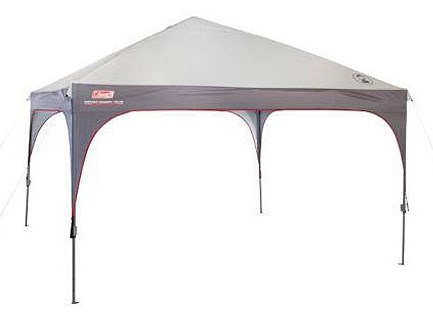
Completing the camping triumvirate is a proper EZ Up/gazebo shelter.  For some reason it’s reassuring to sit under a shelter while camping – perhaps it helps make your camp site feel like actual real estate.  We opted for the Coleman 12’ x 12’ Gazebo.  When compared to a 10’ x 10’ EZ Up, the extra 44 square feet of coverage of the 12’ x 12’ really makes a difference.  It’s big enough for a large number of people to gather under and provides more protection, so items left out overnight under the gazebo don’t gather dew like they would if they were exposed.  Two people can easily put up this Coleman shelter in under 10 minutes, and with 3 or 4 people helping it’s even faster and easier to set up.  I’m glad we got this shelter instead of a smaller and/or cheaper alternative.
Coleman 12' x 12' Gazebo
Now that we have the right combination of tent, cots and shelter, plus some other essentials like the camp stove and table, shade tapestry and coffee percolator, camping is a lot more fun.  We just finished our last planned camping trip of the season, but I’m ready for another one.

Monday, March 11, 2013

First Impressions of the Olympus LS-14 digital audio recorder

Olympus LS-14 Linear PCM Recorder 
I've been using my smart phone or iPad to do some recording at the Irish sessions and old-time jams that I attend, but I don't like zapping my phone's battery to record a long session, and I don't really like carting around an iPad for this purpose and risk having beer spilled on it.  Plus, the sound quality isn't quite there on recordings made with my phone or iPad unless I use an external mic, and then it becomes less discreet and much more cumbersome.

So I decided to get a portable recording device - something digital that's designed for music and not voice, able to record for up to 3+ hours at a time, with good microphones, ability to record as MP3 or .wav, with lots of memory (either built-in or with an SDHC card), long battery life, easy navigation and easy to get files off of, be able to screw into a tripod stand, be relatively small but sturdy and be $200 or less.  Basically I just wanted something I could place on a table in front of the fiddler, press record, and then not have to worry about for the rest of the night.

I came across at least 6 possible audio recorders in my search: the Philips LFH0655, the Sony PCM-M10, the Tascam DR-40, the Zoom H2N, and the Olympus LS-14 or LS-12. I liked how the Philips had 4GB of built-in memory and a rechargeable battery.  Plus, at $80, the price was right.  However, it's more of a voice recorder and I wasn't sure if the recording quality would be good enough.  As far as the Tascam DR-40, I didn't need the ability to record using external XLR mics and I feared that the navigation would be too complicated, so I quickly ruled that one out also.

The Sony PCM-M10 was more expensive than the Zoom and Olympus models, but didn't seem to be any better, and it was older than those, having been out for a few years from what I could tell. So I let the Sony one go too.  That left the Zoom H2N and the two new Olympus recorders - the LS-14 and the LS-12.  My research told me that the Olympus recorders beat out the Zoom when it came to battery life, ease of use, and built-in memory, with the added benefit of being able to overdub.  It then came down to the Olympus LS-14 or LS-12.  

I chose the more expensive LS-14 on the basis that it is supposed to have better mics, and had 4GB of built-in memory, compared to the LS-12's 2 gigs of memory.  In actuality, I probably would have been fine with the LS-12 because I ended up getting a 32GB SDHC card anyway, and have been using that to increase the amount of music I can store on the recorder. Both have a chromatic tuner and metronome functions, which are nice conveniences, but weren't a big factor in my decision.

Here are my first impressions of the Olympus LS-14 Linear PCM Recorder.  I like it!  It's very easy to figure out, even for someone with an aversion to technical stuff like me. As soon as I put the batteries in I was recording with very little confusion.  Then I listened back and was very pleased with the quality.  It was easy to switch the settings to record in MP3 320 kbps mode, which is what I think I'll use most of the time.  (If you want to overdub with a recording, you have to record everything in PCM 44.1 khz mode).

The LS-14 has 3 main recording settings - Smart, Quick and Manual.  Smart allows the device to do a 30 second analysis of the sounds it will be recording and then it automatically chooses the recording level.  Quick is just like you might think - you press record and it quickly begins recording at a pre-set level.  Manual allows you to set and adjust the recording level yourself.  Manual is the one I'll use the most, especially once I learn what the best settings are for the different environments I'll be recording in.  However, I can see situations where Smart or Quick might be useful.

The LS-14's 4GB of built-in memory might be enough for some users.  Office Max had a 32GB HDSC card on sale for $25 last week, so I went ahead and got one of those so I wouldn't have to worry about maxing out for a while.  The battery life is said to be 48 hours.  I've been using the two AA batteries it came with, and after several hours of use it still seems to be on a full charge.  The socket for mounting to a tripod or stand is great, and I've been using the CL2 stand clamp which was included.

Getting the files from the LS-14 to the computer is simple.  My computer recognizes it when I plug it into the USB, and I just copy and paste the files over.  (Backing up the files in a cloud service such as Dropbox is not a bad idea).  I haven't really used any of the editing features yet, such as File Divide, File Trimming and Partial Erase.  This is partly because I downloaded something called mp3DirectCut, so I just do that kind of track trimming on my computer after I've gotten the file off the recorder.  (I wonder if the LS-14 has a way to normalize the tracks - to increase the volume levels without distorting the recording???)

I've had the LS-14 for less than a week as of this writing, but I've already used it to record a banjo lesson/workshop, a live show by a local band, and an Irish Session I played in last night.  Below is a recording from the Irish session.  We were seated around a table and the recorder was laying in front of me on the table, pointed toward the fiddler, flute player, and Irish tenor banjoist. It also picked up the bodhran and guitar backup players - who were kind of on either side. Listen for yourself and let me know what you think!


I'd like to use my new recorder whenever appropriate to capture the tunes I hope to learn and practice playing along with.  If you have similar needs then it could be just what you were looking for.  The 32GB of memory with an SDHC card, which allows you to record up to 1000 hours of MP3 audio or 45+ hours of .wav audio, and the 40+ hour AA battery-life, should make it great for taking to campout festivals like Clifftop or Rockbridge.  I can even see someone recording a My Morning Jacket rock concert with it!  Let me know if you have any questions about this product or would like more information.

Thursday, February 2, 2012

Apogee MiC has arrived!

The long-awaited Apogee MiC has finally arrived.  The MiC is described as being a portable, studio-quality microphone for iPad, iPhone and Mac.  I must say it's pretty easy to use.  When it arrived yesterday I took it out of the box, plugged it into my iPad, opened up GarageBand, and immediately recorded the following tune set.


I'm definitely not a sound engineer (or musician for that matter!) and I hardly did any adjustments for gain or mic placement on these takes, but I think it came out pretty good for a first try.  It's three overdubbed tracks...I recorded a rhythm part then listened back through headphones and played the melody over it (both with my tenor banjo).  Then I had my wife get out her bodhran and add some percussion.  She wasn't that pleased with her playing last night or with the sound she was getting out of her drum, but I think she did OK for someone who has only been whacking a bodhran for a few months.
Apogee MiC

By the way, the tunes we recorded are Whalen's Breakdown - an old-timey sounding tune from Canada in the key of C, and Tralee Jail - a hard driving Irish polka in Eminor (also spelled Tralee Gaol; known in Scotland as Haughs of Cromdale).

I intend to do many more recordings with the Apogee MiC to document our musical progress.  It's portability also makes it great for taking to jams or sessions!

Tuesday, June 14, 2011

Ultralight Tent - BearPaw Wilderness Designs

A couple months ago I got the idea that I wanted a super-light, super-compact two-person backpacking tent.  I did a lot of research, as I like to do when I get a hankering like this, and looked into virtually all of the ultralight makers that I could find, such as TarpTent, Go Lite, BearPaw and many more.  Any of those would have likely been good choices, but I chose Bear Paw Wilderness Designs for the following reasons: a) it is priced very reasonable especially compared to some of the others, b) it seemed to be the most compact design, and c) my correspondence with the owner John Stultz gave me the impression that they take great pride in their work and would do an excellent job.

Initially I was indecisive about which BearPaw model to get, so John patiently went over the different options with me.  I finally decided on the 2-person version of his AT tent, called the AT 2.  This tent is the ultimate in compact size and minimum weight, requiring just two trekking poles to put up - one at the front and one at the back.  (The other BearPaw tent I thought about getting was the PyraNet/PyraTent.  The PyraTent would have offered more ventilation with its removable canopy, but is basically two separate tents - mesh + nylon - requiring more space in your pack, and the pyramid design with one pole in the middle of the tent could cause problems from tossing and turning while sleeping.)

Back to the AT 2.  With two people it's very easy to set up.  My wife and I put it up in under five minutes the first time trying, just by looking at a picture of it...no instructions needed.  I won't always be in a situation where I'll have trekking poles when using it, so I special ordered two poles from BearPaw for setup when trekking poles aren't handy.  (If you are a bicyclist for example, you will need these poles).  You can also tie the front and back top of the tent to overhanging tree limbs to hold it up without using poles at all.

The AT 2 packs down to a size of about 12x4 inches, or 8x8.  Maybe even smaller.  It weighs between 30 and 35 ounces (that's two pounds!).  It's wide enough to sleep two people comfortably, and unless you are 6'6" you should have extra room at the head or foot of it.

Now, with an ultralight tent like this you do sacrifice some things.  For example, I wouldn't want to be in this tent in a high wind because with just two poles holding it up it may not be as stable as a normal tent.  Also, the mesh around the bottom, while necessary for ventilation, could cause water to flood the inside of the tent during a heavy rainstorm because it didn't really seem to form a "bathtub" when we tried it out (this could be due to how we had it staked out).  The design could also present some challenges for beach camping; it seems like the poles would need a hard surface to keep the tent upright.  I'm also curious about the ventilation, as in how much condensation will build up in it.  I will know better after having actually spent a night in it. 

Here's a picture:

BearPaw Wilderness Designs AT 2 tent.
All in all I'm very pleased with the tent and BearPaw is a company that stands behind their product and is a pleasure to work with.  I intend to camp in the tent  by the end of July, if not sooner, and will post a followup after doing so.